How to Train a Dog
How would you define dog training? ‘Wikipedia’ provides the exact quote ‘the application of behavior analysis which uses the environmental events of antecedents and consequences to modify the behavior of a dog’ (no wonder people say Wikipedia is a poor source to reference). Though this might be correct, it is still difficult to understand and a pretty terrible explanation!
Or, you could just get rid of that ridiculously over-worded nonsense, and use these three simple words that explain the entire process unbelievably better: Learning through Conditioning.
How Do I Train MY Dog?
Anyone inexperienced with dogs or animal training probably dreads this question. The thought of training an animal, of teaching human skills and behaviors to something far from human, can be overwhelming. You’re probably expecting countless hours, even days of research ahead.
What if I told you the whole thing is actually pretty simple? You could read all of the advanced dog training textbooks you want, or watch countless training videos, but still won’t get anywhere unless you first understand three very simple things:
- What does your dog want
- What ‘drives’ your dog to choose one thing over another
- How can you use these drives to accomplish your training goals?
There are MANY dog training terms, but only a few are important to understand for basic dog training.
Conditioning
This is the ‘All’ of dog training, the most basic term that covers just about everything! If you want to learn how to best train a dog, or at least how to begin, you’ll need to understand conditioning, and no, we’re not talking Rocky Balboa conditioning here.
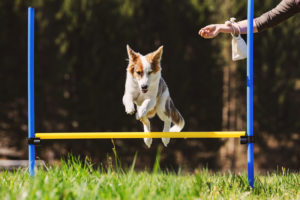
Dog Agility training with a cute puppy dog on the meadow, Hurdles and obstacle
Basically, behaviors are changed as a result of some type of experience. Through repeated actions (ideally the same actions), your dog forms connections and associations. Your dog is learning!
Example: You reward your dog to perform a ‘sit’. When your dog ‘sits’, you give him a treat. By repeating, or reinforcing, this several times, eventually your dog has learned what you want him to do when you tell him to sit, and also learned that performing a ‘sit’ for you means he gets a reward. You have conditioned your dog to sit when you give the command.
Another Example: You install an ‘underground’ fence surrounding your property. Every time your dog ventures to close to the border, he receives a slight jolt. Very quickly your dog will associate that jolt with the border of your property, and no longer want to get too close to it.
Again, an association has been made through repeated behaviors; your dog has learned!
Operant Conditioning
This involves learning through conscious rewards or punishment. When you reward with a treat, offer a vocal correction or administer a jolt from that E-collar when your dog gets too close to deadly traffic, your pet is learning through Operant Conditioning.
This is what most people think of when dog training comes to mind. Your dog makes associations between behaviors and the outcomes of those behaviors.
Classical Conditioning
Your dog is associating something neutral (like a sight or sound) with a consequence or outcome. If you’ve graduated from high school in the US, you’ve almost certainly heard of this (though you may not remember).
Does your dog become excited when you pick up a leash? All you did was pick up a leash. You didn’t reward your pet with anything, or say anything. Your dog has formed the association between the leash and the walk that leash signifies.
Does your pet becomes anxious or agitated when he sees those nail clippers in your hand? What reaction do you get when you lift that bag of treats?
Repetition
Unless you are using intense punishment/aversive techniques that cause your dog to fear for his well being (which is usually a poor idea), you can’t do things once and expect your dog to learn. You need to reinforce your training by repeating actions multiple or several times before your dog makes associations. The exact same thing is true for human children at school.
Example: Very few children learn the spelling of a complicated word, or the meaning of a particular word in another language, the very first time they hear it. These meanings have to be reinforced by repeating them several times. The same is true with dogs!
Reinforcement
Reinforcement ties in with conditioning, and is exactly what the word implies. If you give a treat, or reward with praise, after your dog does something you want, you’re reinforcing their desire to do it again the next time.
It’s very important you reinforce your dog’s learning. You need to give your dog either a reason to want to do something you want him to do, or a reason not to do something you don’t want.
Positive Reinforcement
Most people assume this must mean good, pleasurable things for the dog, due to the word ‘positive’. That’s not actually what it means; positive simply indicates the addition of something, where Negative Reinforcement means you are reinforcing a behavior (or the lack of a behavior) by taking something away.
Positive = addition
Negative = subtraction/removing/taking away
Clicker Training
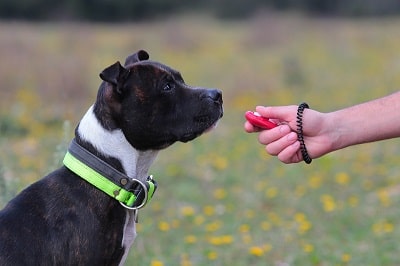
Believe it or not, clicker training actually began with dolphins. Eventually, a creative dog trainer discovered the same idea can work, and work very well, with dogs!
positive training
The sound of a clicker is simply meant to be a marker, a way of bridging the gap between your dog’s behaviors and their outcomes. It can take a second to shout a vocal response, and a few seconds to reach into your pocket for treats, but it takes a mere fraction of a second to ‘click’ a button. There is no time for your dog to confuse any other behaviors.
The ‘click’ tells a dog something was done correctly, and that some type of reward is coming. You should always follow a ‘click’ with a treat reward. Once you have a firm grasp of the psychology behind clicker training, you can begin to change up your reinforcer rewards.
You can find a decent quality clicker like this one at a reasonable price with rave reviews:
PetSafe Clik-R Trainer
-
-
-
- Hand-held clicker with finger holder
- Introduction to clicker training guide included
- Call, chat or email with our expert US-based customer care specialists six days a week; They are waiting to assist you and your pet with your product needs
- PetSafe brand has been an industry leading US manufacturer of pet behavior, containment and lifestyle products since 1991, helping millions of people and pets each year
-
-
Perhaps you just got a new pup and need more than just a clicker? One of these package deals might be a better buy for you:
Dog Clicker Treat Walking Training Pouch Bag Bonus Clicker Trainer – Built-in Double Poop Bag Dispenser, Drawstring Closure – Carries Balls, Toys, Treats – 3 Ways to Wear
-
-
-
- NEW! PET TREAT BAG, TRAINING TREAT POUCH: Ideal for clicker training, holds all dog training treats and toys you need when out and about with your dog.
- BUILT-IN POOP BAG DISPENSER: Be prepared, easily pull and tear poop bags from built-in dispenser. Holds up to 2 poop bag rolls.
- DOG CLICKER TRAINER INCLUDED: Bonus clicker means you can combine walks with learning and bonding, pet clicker can be attached to 2 convenient d-rings while obedience training.
- The removable 42″ adjustable shoulder strap doubles as waist belt, or you can use the strong belt clip. Pouch is premium canvas fabric material, water repellent.
- STORE YOUR PHONE, KEYS, DOG TRAINING TREATS: 2 zippered pouches and front mesh netting hold your smartphone, money or keys. 100% money back guarantee.
-
-
PERRAMA Dog Treat Bag, Training Pouch for Small and Large Dogs with Clicker and Collapsible Food Bowl BPA Free – Pet Treats Tote Bag with Waist and Shoulder Reflective Straps and Belt Clip
✅OUR PETS, OUR FAMILY! – Not just our motto but the principle we had in mind when we created your Perrama Treat Bag for Dog Training. With a practical design it securely holds in generous amounts of dog training treats, kibble, accessories and dog toys. Use your waist treat pouch, FREE training clicker and dog bowl for the best training experience of your life!
✅A TREAT POUCH CAN BE A LIFESAVER – Especially if you’re training a pup and we, the dog owners, know the importance of having treats on hand. A truly great dog treat training pouch should fit your essentials and keep them organized at all times. With two pockets, one large compartment, and a poop bag dispenser, Perrama Pet Treat Bag keeps everything organized and within easy reach.
✅DOGS LOVE TO HAVE JOBS – Keep your dog active with a great training in the park or just enjoy a fun and peaceful morning walk. Whatever you choose he will be happy and healthy. In any of these occasion Perrama Dog Training Bag offers multi-wear options. Featuring two adjustable straps and one metal belt clip, the training treat bag can be carried on your shoulder, as treat waist pouch or attached to your belt.
✅SECURE SPACE FOR YOUR STUFF – You can safely store your smartphone, money or keys in the zippered pouch or front mesh netting. Plus, since it is small and lightweight, it is not cumbersome to have along with you. You will love this and it will make training and walks so much easier and fun! It even features a reflecting strap that keeps you and your friend safe during night walks. Isn´t this great?
✅YOU ENTER IN OUR LIFE as a customer but you will leave as a friend. For all our friends we guarantee our Dog Treat Pouch with full 100% MONEY BACK if you just simply find out it is not the best suit for you. Mentioning we are also offering a free e-book TRAINING GUIDE you can find no reason why not to CLICK ADD TO CART NOW!
Punishment Training & Aversives
‘Aversives’ are unpleasant stimuli that are often used in Positive ( positive = addition) Punishment type training in order to discourage or decrease a behavior. A jolt from an E-Collar is an aversive, for example.
Most forms of punishment based dog training are frowned on today, now that our understanding of dog behavior has increased significantly. That being said, it still can play a very important role if used correctly!
For example, the savvy trainer might carefully administer a jolt when their dog ventures too close to a large road with busy traffic. If the owner repeats this every time the dog gets too close to deadly traffic, soon the dog will begin to think the road caused his discomfort and avoid it entirely.
This is the exact principle behind enormously popular ‘underground fences’.
Now that we’re here, lets talk E-Collars!
We happen to prefer E-Collar Technologies e-collars.
If you pay close attention you’ll notice many of the professional trainers use the exact same device. They just white label the device, put their own logo on it, and then upcharge you for it! Why pay $250 for the same device you can get from the actual manufacturer for $179?
Their half mile range mini educator unit used in conjuction with a good training plan works wonders and at $179 on Amazon it really can’t be beat.
Educator E-Collar Remote Dog Training Collar
-
-
-
- One dog system with 1/2 mile range
- Small receiver (2″x1.5″x1″, 2.4 oz) for dogs 5 pounds and larger
- Mini ergonomic “stopwatch” transmitter (2.64″ diameter x 1.29″ thick) is well-suited for small hands or in situations where discreetness is important
- Delivers a tapping sensation similar to vibration, but more intense, making it an effective addition to the stimulation
- User-selectable stimulation levels from 1 to 100 with additional boost stimulus selectable from 1 to 60
- Includes two sets of contact points (5/8″ and 3/4″).Biothane collar strap: ¾ X 30 inch, 1.46 ounce (Ready to cut to size)
- Lithium-polymer rechargeable batteries with dual charger; 2-hour full charge
-
-
If that’s too steep a price, and quite frankly we’re not sure any price is too steep to keep our furry friends away from the road, then our BEST BUDGET PICK would be the Mockins unit:
Dog Training Collars with Remote – Shock Collar for 2 Dogs, Small, Medium, Large, Rechargeable 100% Waterproof E-Collar with 3 Training Correction Modes, Shock, Vibration, Beep, 1000 ft Range
-
-
-
- 🐶Train dogs like a Pro – the Petrainer multi dog training collar with remote is the most effective behavior correction technology available with 3 safe effective training modes to fit your dog’s needs! Between the 0-100 levels of vibration, shock, and standard Tone, You can rest assure that your pet can be trained!
- 🐶Enjoy time with your dog without worry or anxiety! – educate your dog with confidence by applying adjustable attention-grabbing: Tone & vibrating stimulation for moderate misbehavior or safe static mode for stubborn pets!
- 🐶Rechargeable waterproof Remote – With the ability to charge your transmitter and receiver simultaneously, you are to easily train your pet in the rain or sunshine with a range up to 330 yards!
- 🐶Adjustable for all size dogs – Our training collar is adjustable ranging from 14-25 inches. We that it will fit your small, Medium, or Large size pet! Petrainer e-collar nylon strap helps protect your dog’s sensitive skin.
- 🐶Customer satisfaction – click “buy IT now” then register your device to receive free extended 3 year ! Contact our US based customer service team (phone/email) 5 days a week! Reach us at for all trouble shooting issues.
-
-
We hope this helps in your training adventures. We’ve tried it all to be quite honest. From just a leash and treats, to clickers and treats, to e-collars and treats. We tend to prefer the e-collar and treat methods ourselves, but be sure and check with your dogs veterinarian as you may want to wait on the e-collar training if your dog is less than 5 months. You can still work on clicker training younger, but we recommend waiting a bit longer for the e-collar.